Digital Earth Africa (DE Africa) and the Kenyatta University in Kenya are collaborating to train the next generation of future leaders that will use earth observation for natural resource management. This has been possible courtesy of Dr Particia Mwangi, a lecturer in the Department of Spatial and Environmental Planning.
Digital Earth Africa (DE Africa) and the Kyambogo University in Uganda are collaborating to train the next generation of future leaders that will use earth observation for natural resource management.
Sena Ghislain C. Adimou is a geospatial analyst and systems administrator at the African Regional Institute for Geospatial Information Science and Technology (AFRIGIST) in Ile-Ife, Nigeria. He is a stalwart champion of DE Africa, having been present from the early days of the program, watching as we have matured and expanded across the continent.
Julius Buyengo is a Geo-Information Science and Earth Observation expert leading Digital Earth Africa projects at RCMRD. As a member of DE Africa’s Technical Advisory Committee, he is dedicated to advancing geospatial innovation, capacity development, and impactful decision-making across the continent. We caught up with Julius to learn more.
Could you briefly share your own professional background?
It's always exciting when two human-centered programs come together to lay the groundwork for impactful action based on a shared vision.
The Sahel and West Africa Club (SWAC), part of the OECD, and Digital Earth Africa (DE Africa) share a common goal: to provide data-driven insights that inform high-level decision-making and ultimately drive positive change for African communities.
OECD/SWAC: Fostering Regional Cooperation and Development
The destruction of natural resources in Africa has escalated at an alarming rate, but without the necessary measurement and monitoring to draw the necessary conclusions. Africa had the largest annual rate of net forest loss in 2010–2020, at 3.9 million hectares. This rate has increased in each of the three decades since 1990.
Digital Earth Africa and the University of Energy and Natural Resources (UENR) of Ghana are forging a non-binding partnership aimed at harnessing the power of geospatial and Earth observation data for environmental and development issues, as well as capacity building and project implementation. This collaboration seeks to align the core missions of both organizations, with UENR focusing on delivering data and outcomes that align with the DE Africa program.
Digital Earth Africa and Digital Earth Australia feature in the latest art installation from Grayson Cooke.
Digital Earth Australia (DEA) and Digital Earth Africa (DE Africa) have been featured at Grayson Cooke’s art installation at the Society for Ecological Restoration Conference hosted in Darwin, Australia.
A cloud-free image of all of Africa produced by combining tens of thousands of satellite image collected throughout an entire year. The new AWS data centre in Cape Town stores millions of images, making these new products possible
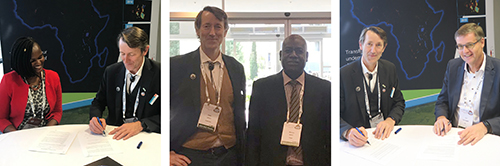
We recently signed mutually beneficial agreements to help us ensure that anyone can use Digital Earth Africa (DE Africa) by providing the skills and expertise required.